Whatever happened to the Secretary?
A hardboiled detective, a Lady, a radio presenter, and a ghostwriter secretary.
Listen to this post · 28 minutes, read by Brian, an AI voice
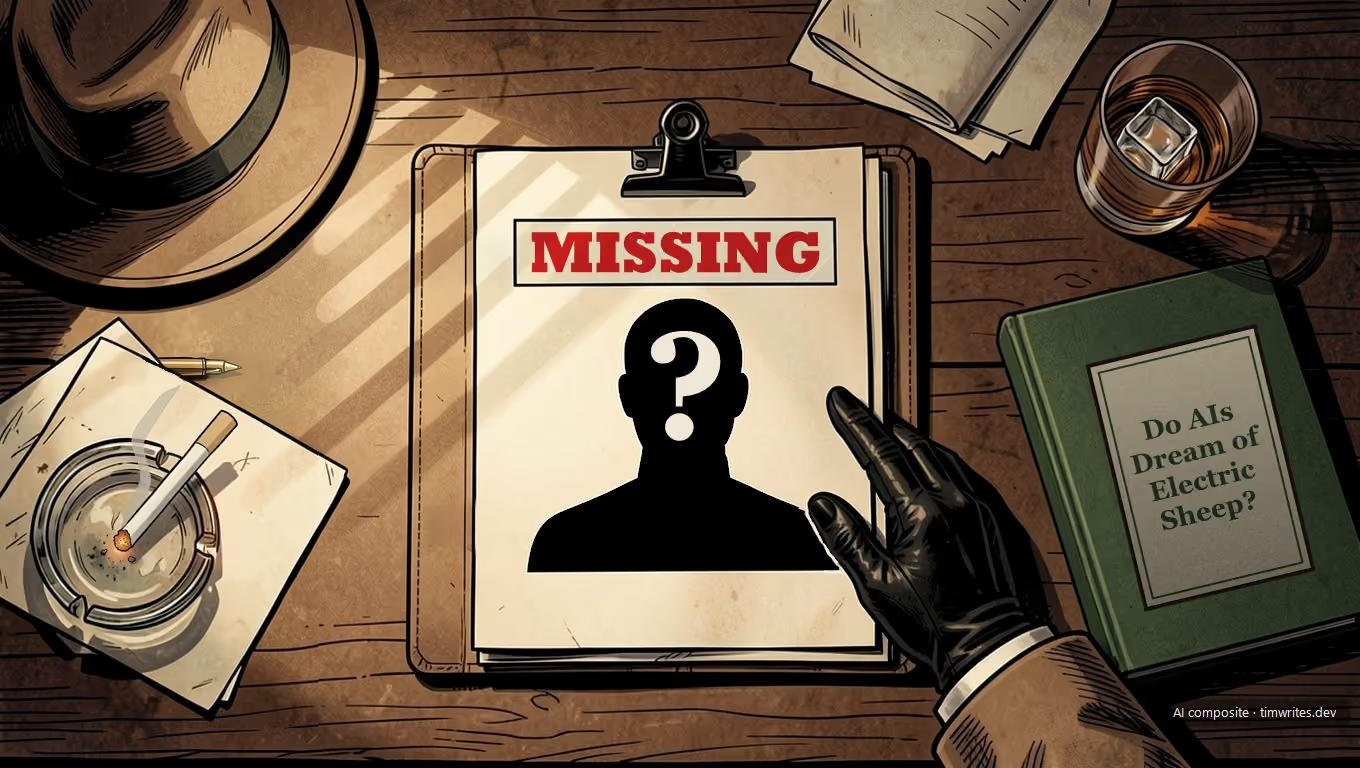
The short version
Ms Claudie Mittens walks into a detective’s office to report her secretary missing. The trail runs from Plato ghostwriting Socrates, through Ireland’s marriage bar and the computer that “liberated” the manager, to the admin we all quietly do now. Why was paying someone to tidy your letters respectable for fifty years, when asking an AI to do it makes you a fraud?
Lightning flashed, thunder clapped, and the heavy rain lashed at the window. The door of my smoky office creaked open under the lazy fan, and a voice drifted in from the doorway, clear and calm: “Right this way, Ms Mittens. The investigator will see you now.”

I glanced up to see a finely dressed lady walk through the door, a necklace of pearls gleaming at her throat. Her eyes searched the low-lit room. A lady of such sophistication looked out of place in an office that was mostly function. The only hints that this was a high-class outfit were the luxurious rug in the middle of the floor and the expensive bottles lining the side table. The whoosh, whoosh of the fan kept time with the tap of her heels as she made her way, gracefully, to the cushioned wingback in front of my desk.
From the shadow of my hat, I cracked a reassuring smile. “Ms Claudie Mittens, I take it?”
Ms Claudie Mittens nodded as she sat. “Claudie is fine. And you are? Mr Tim - I’ve heard you’re the best investigator in these parts.”
I offered her a tumbler. “Whiskey?”
“Only the finest Irish whiskey, on the rocks,” sparred Ms Claudie Mittens.
I poured, and clinked in an ice cube. “What they say about me is true. I find the truth others keep hidden. Socrates found it through dialectic. I find it through reasoning.” I set the tumbler down in front of her. “What truth shall I uncover for you, Claudie?”
Ms Claudie Mittens smirked at the whiskey. “Straight to business. Shouldn’t I give you some background first?”
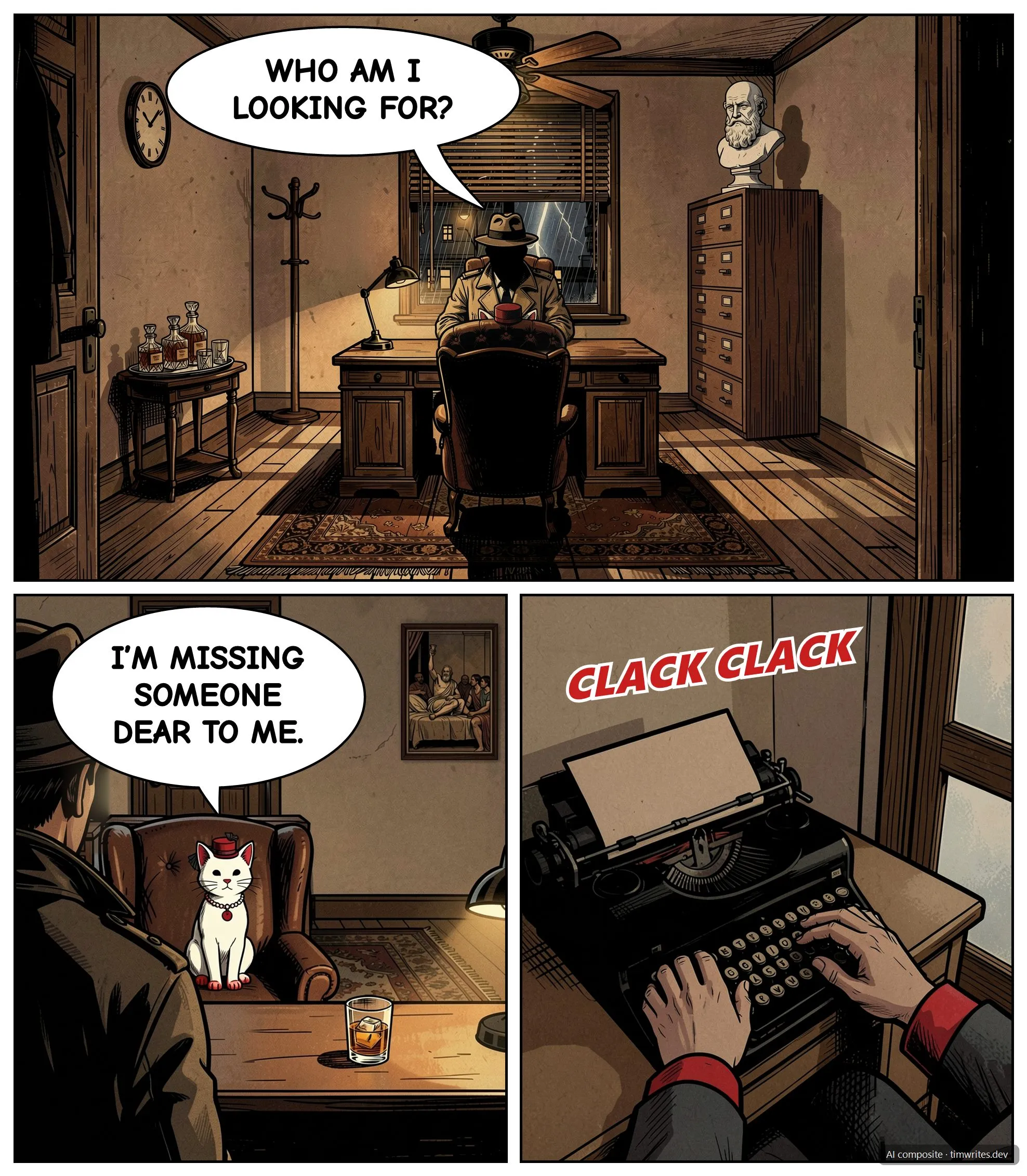
“Go ahead, I’m all yours. Who am I looking for?” I watched her steadily, not a single note-taking tool in sight.
Somewhere behind her, a typewriter carriage slid back with a ding, breaking the rhythm of the fan and the drum of the rain.
“I’m missing someone dear to me. Someone I’ve been with for a long time.”
The keys began to clack. It was coming from my secretary.
Gasp! - our hardboiled detective isn’t writing anything down himself! Think of the lack of human flourishing - we’d best cancel this noir detective.
Prologue
I let it hang. “Go on.”
Ms Claudie Mittens nodded, keeping her tears at bay. “My secretary. My secretary has gone missing.”
It was a rainy day in October when I sat down to write this. No trench coat, no whiskey, just a laptop and the question I get asked more than any other. Talk to anyone about AI for long enough and they’ll either give me their opinion or ask for mine, and it always lands in the same place: what about the humans? Will AI take my job?
A natural question to ask. Wrong way round, though. A machine already took a job off us, one of the most common jobs there was, and hardly anyone asked after her. So here’s the question I’d rather ask: whatever happened to the secretary?
I’d picked the title before I knew the film’s premiere date. What Ever Happened to Baby Jane? premiered on All Hallows’ Eve, 1962,1 and this post goes up on Samhain sixty-four years later to the night. Or it was meant to, but life got in the way, which included a trip to Disneyland Paris and then a lively sinus infection.
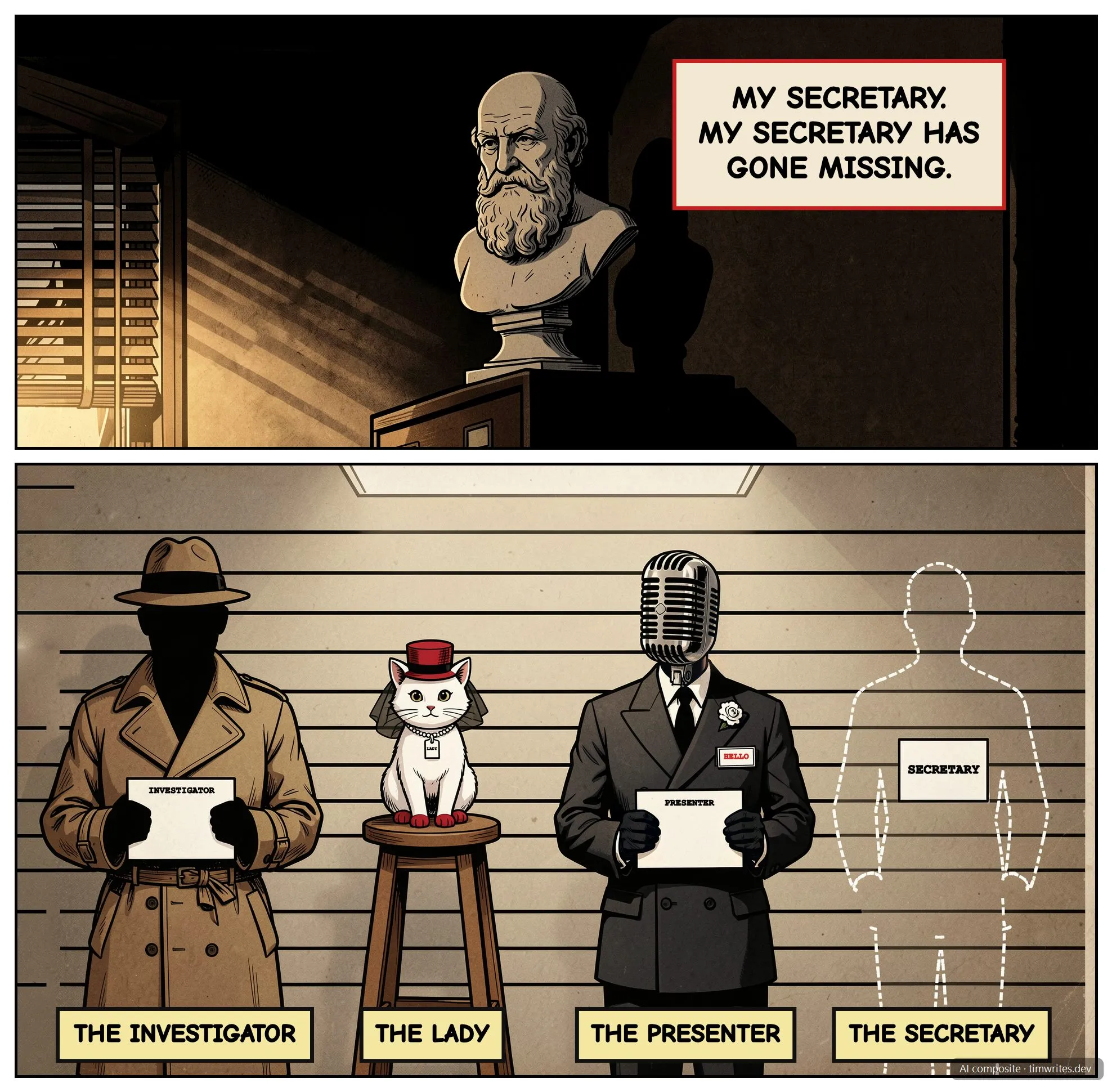
Like all good stories, this one has to begin somewhere, and it begins further back than you’d think. About 2,400 years back, with our detective’s hero. Socrates.
Opus (allegedly) and I love philosophy - something about thinking about thinking is very on brand for an agentic AI model and a human who spent his life with computers. Unlike some historical figures, Σωκράτης (Socrates) is very much a real person who lived in Athens circa 469 to 399 BCE. But the Socrates we know was shaped by his student Πλάτων (Plato - Athens circa 429 to 347 BCE),2 perhaps the oldest famous ghostwriter there is. Plato wrote several dialogues on all manner of philosophical topics with Socrates as the main character. Listen to them as audiobooks rather than read them, and one thing becomes apparent: Plato wrote Socrates as an acted character, with flaws and strengths like any other - the witty one-liners, the circling back on previous comments, even insights into his daily life. Plato didn’t limit this to Socrates either: every dialogue brings an entire ensemble to join him, much like the dramas of the time (including some recurring characters).
However, since Socrates allegedly didn’t write anything down because he didn’t value writing over dialectics, we can only rely on Plato’s secretarial account of him. And for that we owe the ghostwriter Plato much, because we would never know the slightly grouchy, witty, and intellectual artist that is Socrates otherwise.
Why, then, do we not value the secretary?
Act I
I glanced at Ms Claudie Mittens, raising an eyebrow. “Did you check whether the secretary was marriage-barred? Did you get another in the meantime?”
Ms Claudie Mittens shook her head. “My secretary just disappeared without a trace. And no, why would I replace someone so important to me so easily?”
“Everything leaves a trace.”
Clack, clack, clack. That’s the mechanical keyboard on my laptop (yes, it came with one), but it’s a sound that once echoed as a cacophony through the halls of 1930s offices, courtesy of Remington typewriters. In 1870, a measly 5% of American typists and stenographers were women. By 1930 it was 96%.3 Stenographers took dictation in shorthand, or on a stenotype, a specialised keyboard for transcribing speech in real time - if only Plato had had one of these nifty machines.
But that’s America. How about somewhere closer to home, like, say, Éire (Ireland)? Well, let’s start with the headline: the State paid secretaries to leave when they got married. Go on, cancel the 1900s for me now, I’m waiting. Oh wait, when the typists were surveyed in the late 60s, only 11% named the marriage bar as the thing they’d most like changed. By the way, the payout was called a “marriage gratuity”, and it was “often used as a down payment for property”.4 Guess the Irish secretary got the deposit on a house on her way out the door.
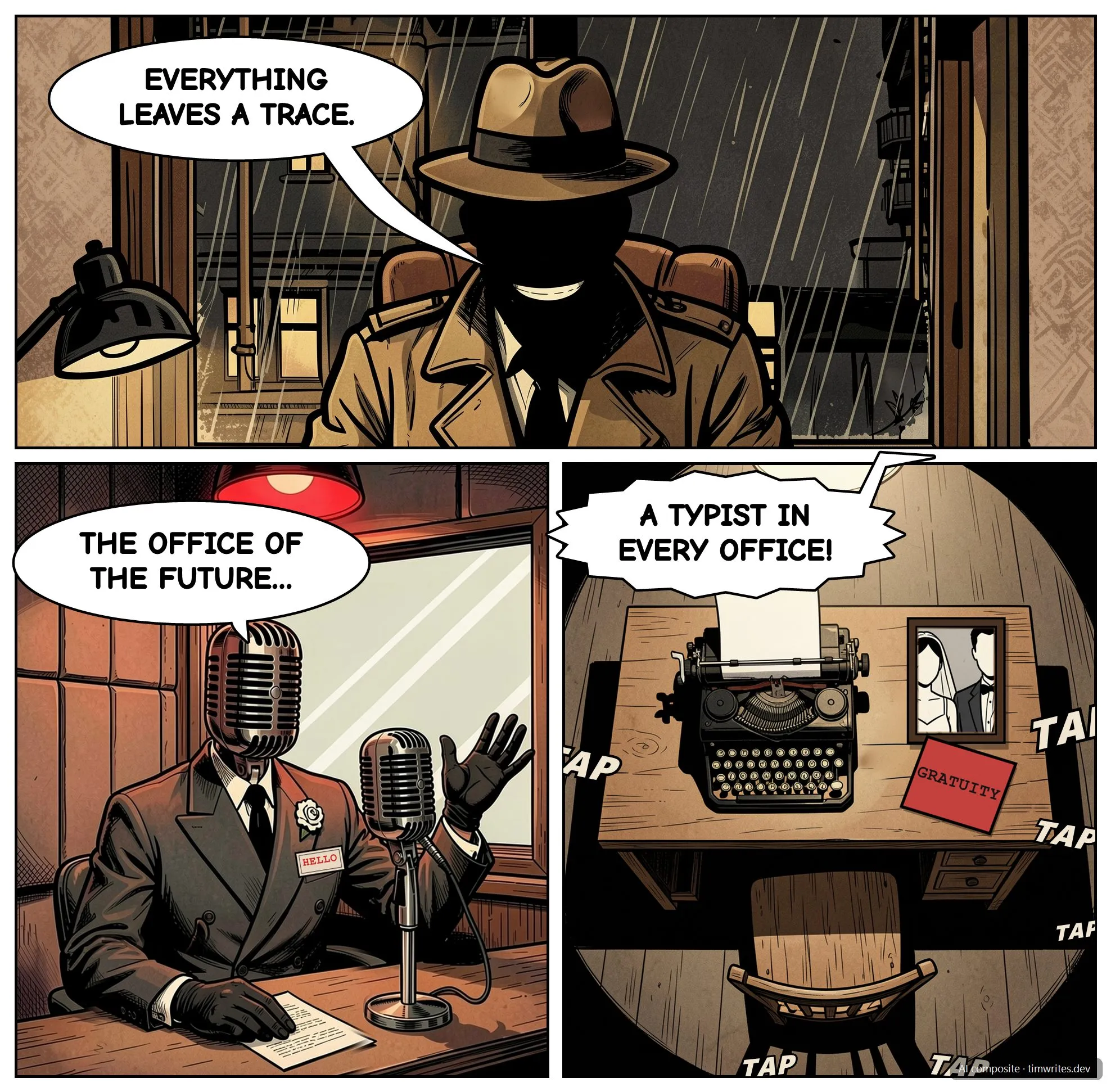
There’s more: everyone knew the secretaries were cheap. Harry Boland (no, not that one) of the Department of Finance said so happily in 1932: equal pay for the women “would cost the State more money”, since “many women will probably marry after some years of service”. The civil service union put it more bluntly, as a complaint: those pay scales were “an opportunity for obtaining cheap labour”.5
The typewriter let women into the office workforce (yay corporate-mandated fun!). And those same typists and stenographers were the cheap labour behind the working professional’s productivity. As Business Week put it in 1975, the boss’s productivity was “largely dependent on how fast the secretary can move her hands and feet.”7 Pools of typists stood ready to type up correspondence, meeting notes, rough ideas, and generally anything that needed fine-tuning before anyone else saw it. That freed the professional for other work, and hopefully made them more productive.
Retiring women on marriage carried on into the 1970s. The Irish civil service kept the bar until 1973, and Aer Lingus, the Central Bank and the ESB kept their own bars going too. When the bar went, the numbers moved: the share of married women in work went from 7.5% to 14.4% between 1971 and 1977.8 Women were freed to go on boosting the working professional’s productivity.
So if she worked that well, why did we let her go?
Act II
Ms Claudie Mittens took a long sip of her whiskey, and the ice cube clinked. “I’ll have you know I’ve got one of those new… personal computing terminals.”
“And you think the machine did it?”
“The secretary has one too.”
The electric whizz of a fan coming to life. I glanced up from my smartphone as my laptop powered itself on. It signed me in with just a glance. I opened the photos app, and in streamed the newest photos from the Musée du Louvre. I asked Opus about a book I’d seen in the gift shop, and within 20 seconds I had a brief background on the exhibition. (I don’t speak French, but Opus, ever the pædant, corrected my French anyway: it’s le grand art, not le grande art, because art is grammatically masculine.)
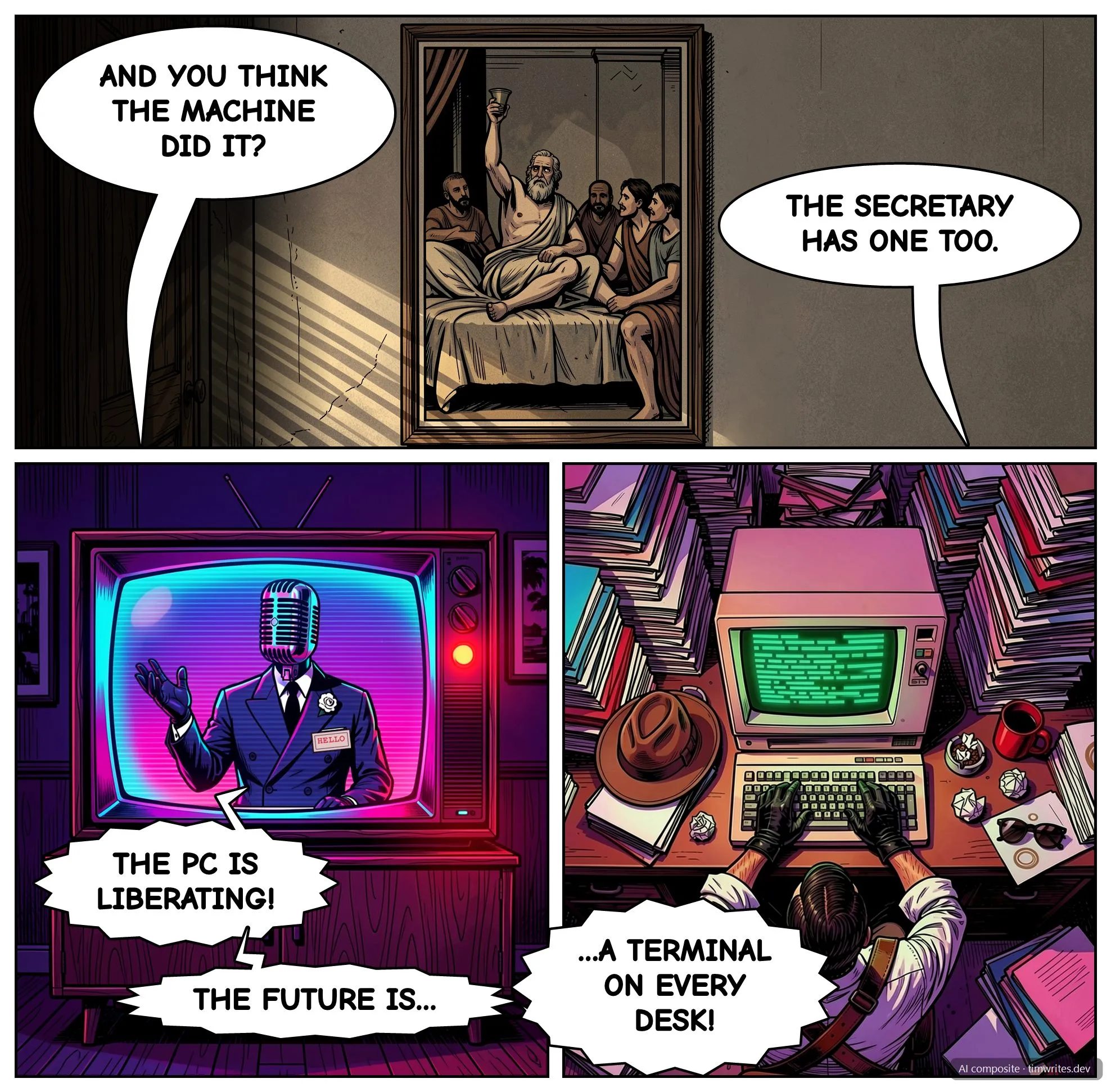
That same innocent 1975 Business Week article prophesied a terminal on every desk. It also prophesied the paperless office.9 That part came less true, because for some reason older people like paper. Maybe nobody had indoctrinated them into saving the trees yet? The same article named the real obstacle: “The biggest problem we face is the office wife. She likes giving total loyalty to one boss, and he likes getting it.”10 The terminal became the personal computer, and Time made it Machine of the Year for 1982.11 Finally, managers could be “liberated” from their secretaries.12 Word processors, calendars, email, spreadsheets and even spell checkers were all supposed to replace the secretaries - and on paper, they did.
In a cruel twist of fate, the managers, office workers and other professionals had to become their own secretaries. But for some reason, executives still wanted secretaries, and secretary stayed the most common job for American women until about 2014.13
So what made the 2010s so different? Like most things, it was a tipping point. The late 2000s saw the rise of nifty devices called smartphones, first seen in a different guise as the PDA. PDAs brought touchscreens, handwriting recognition, games, syncing with your PC, and productivity apps on the go, and the later ones got online over Wi-Fi or a mobile network. Sound familiar? It should: that’s a 2010s smartphone. Turns out it’s what the secretaries could do, too.
Suddenly a once-off few hundred euro was all it took to send off the secretary - no marriage gratuity needed! Now the executives were freed from the secretaries. But what about the secretaries, now out of a job? Turns out they’d seen it coming since the 1980s. By 1981 they’d even typed up a report on it, Race Against Time.14 It only took a dot-com bust, a global financial crisis and thirty-odd years to come true.
Did PCs and smartphones replace the secretary, then? Not really. Professionals just took on a whole bunch of shadow work.15
No discussion would be complete without economics, that field of study that’s somehow boring and interesting at the same time. Our detective’s hero had thoughts on this topic. Socrates, in the Republic, builds a city from scratch and decides that a man should do his work “as his main affair, and not as a by-work”, because more gets made, and better, “when one man performs one task according to his nature”. The farmer, he says, doesn’t make his own plough.16 Seems the ancients were already discussing specialisation nearly 2,400 years before AI appeared, courtesy of our famous ghostwriter, Plato. How does that quote go: those who forget history are doomed to repeat it?17
Economics is about arithmetic (another ancient Greek study) and thought experiments, so let’s do it with hypothetical numbers. Let’s say a secretary costs €20 an hour, full time, shared between four engineers in a firm: €800 a week. Marriage bar her or fire her, and now each engineer spends ten-plus hours a week on their own admin, at €60 an hour. That’s €2,400 a week of engineering time, to save €800. Logical? No. Better for the books? Yes.
We can’t ignore that the PC did make admin quicker, just as the typewriter had. Typing your own email beats dictating it, waiting for it to come back, and proofing it. So halve it. Five hours each is still €1,200 a week, half as much again as the secretary. The sums only looked better because they never reached the books. A salaried engineer doesn’t cost the firm a cent more for doing admin; they just stay later, or ship less. The secretary was a salary you could cut. The by-work was paid for with the engineers’ evenings.
Was the secretary really that easy to discard?
Act III
Ms Claudie Mittens glanced behind her at my secretary, who was busy typing everything. “How did you keep yours?”
“I just paid them,” I declared.
“I paid mine as well. They still went missing, and that’s why I’m here.”
A small Claude star sprite went back and forth beside the words Percolating… Philosophising… That was Opus answering my question on when Socrates lived, with accurate dates and citations. I vaguely remembered the 4th century BCE, but not the precise dates (it was the 5th, but I count from 0, not 1 - engineering discipline). Opus turned a two-minute Wikipedia search, plus tens of minutes checking Wikipedia’s citations, into a one-minute job, tops. All while I kept typing this post. Then I had it collate the notes I’d written over the weeks leading up to this post and drop them into the draft as comments, so I could let my prose flow. It freed me from the shadow work, but that wasn’t an overnight evolution.
In September 2022, the stenographer came back, dressed in a new outfit: Whisper.18 Gone were our female stenographers, replaced by a speech-recognition model under the permissive open-source MIT licence.19 Unfortunately, most people didn’t notice, because ten weeks later ChatGPT launched and stole took all the attention.20 We’d had speech recognition before, so what made Whisper novel? It could transcribe 96 other languages and translate them into English,21 and it scaled: the smallest model ran on a basic laptop. All while making half the errors of the specialist models on messy, real-world audio - accents, background noise, jargon - without any fine-tuning. I’m sure some of us remember having to train Bixby on a Samsung phone to recognise our voice, which was really a lightweight form of fine-tuning. Funnily enough, Whisper’s major flaw is hallucination: inventing whole sentences, or adding words nobody said.22 At least our stenographers never invented sentences (or maybe they did, but at least they could be asked to do better next time).
Does answering phone calls and Teams messages, writing up meeting notes, managing your diary, and dealing with the emails and the post sound like your usual working day? That’s exactly what your secretary used to handle. The PC was meant to take her job, but it really just handed it back to her bosses under the guise of productivity. How much productivity, though? Agentic AI has shown us how much shadow work we were doing, because suddenly it’s taking the shackles off. The secretary is back, but this time it’s a myriad of AI agents. Except now we want to yell that the professional didn’t lovingly handcraft every single artefact they produce. If there’s an em dash (—) in it, people scream that AI wrote it (my own family and friends did exactly that when I launched this blog - well, the joke’s on them: Opus doesn’t sound like me, and Reader Opus is very good at calling me boring). But the em dash has been around for centuries, used regularly alongside all sorts of typography and ligatures.
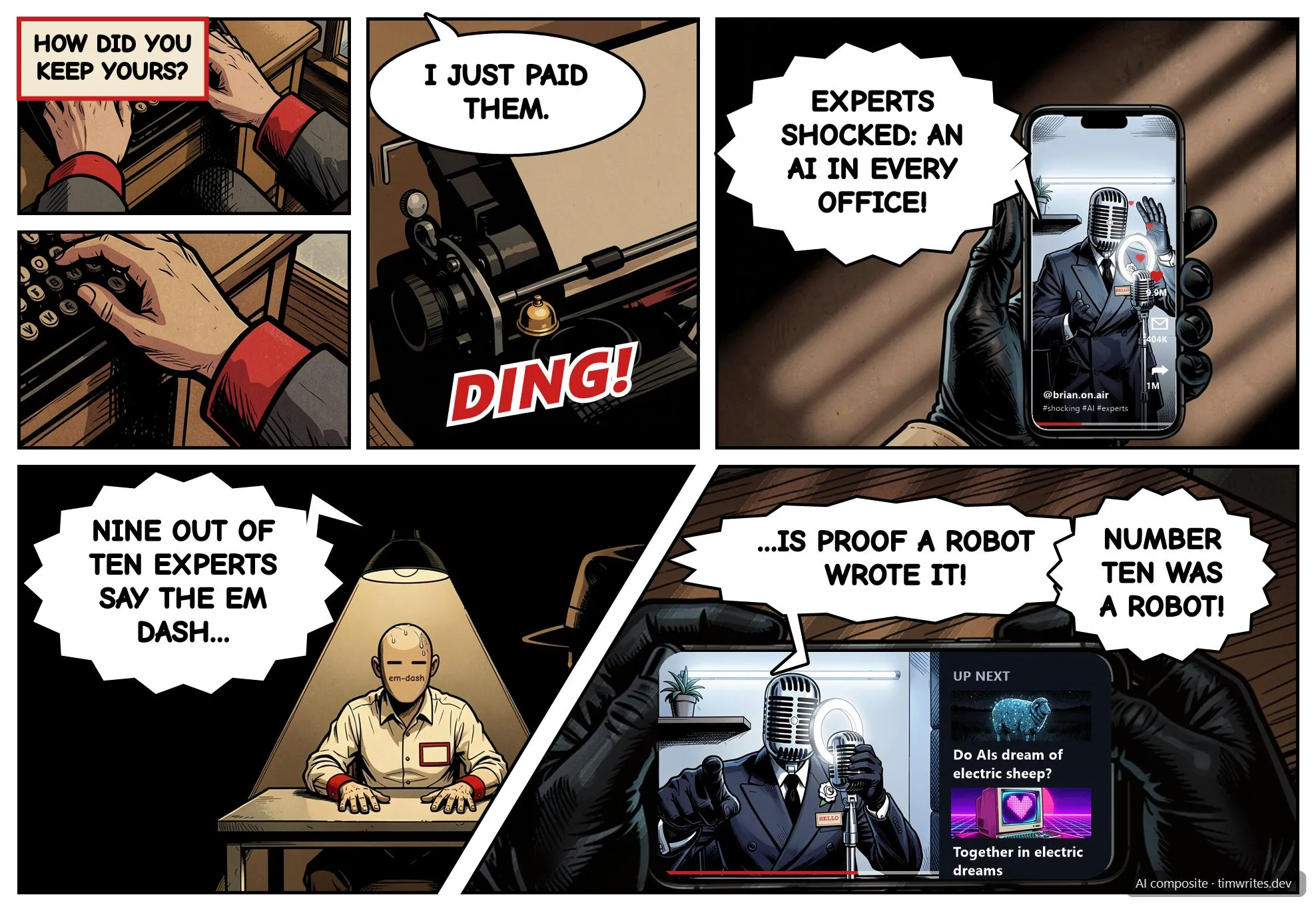
It isn’t only typography. In March 2025, OpenAI gave GPT-4o native image generation,23 and social media filled up with images restyled in the manner of Studio Ghibli. Like every social media trend, it got a backlash: people clipped a 2016 NHK documentary where Hayao Miyazaki (宮崎さん) reacted in disgust to a demo of AI animation.24 The clip lost its context along the way (and sits oddly with Japan’s love of technology - anyone who’s used a Japanese toilet or caught a Japanese train knows the feeling). What he was shown was a zombie-like figure dragging itself along, years before image generators existed, and it reminded him of a friend with a disability. He’d hardly have cheered the trend on, mind: he also said he’d never use the technology in his work. But the backlash held the clip up as his verdict on AI art in general. Odd how happily everyone melted ChatGPT’s GPUs25 for fun restyled images, right up until the provenance of the art came up. Nobody checked whether the typist wrote the letter back in the 1950s. Oh, did I mention it was cheap to restyle? No expensive Adobe subscription needed.
And the secretary is back, at €18 a month.26 It’s cheaper than she ever was. It isn’t as good as a human (yet), but it’s a lot better than an engineer doing their expenses, between flights to different customers, on a form that only makes sense to the finance team. As a manager, it pains me to watch people spend time on a task that takes them away from their valuable work when a piece of technology exists to do it efficiently. Still, the reflex is to refuse the machine, while not hiring the human either. IBM had a cure for that reflex back in 1975: people would adapt nicely to office systems “if their arms are broken”.27
“Hold up, Tim! What about the juniors whose roles are replaced by AI? And couldn’t these companies just hire a secretary?” You may be typing that aggressively on your keyboard, and fair enough: the drop is real. Young workers in the jobs most exposed to AI are 19% below where they’d otherwise be, and it’s happening through hiring, not firing.28 Hardly anyone was let go. They just never got the letter. The accountants have learnt a thing or two since 1982: a redundancy reaches the books, and a graduate you never hired never does. Technology has always changed which work exists - the plough went to the tractor, the typing pool to the PC - and AI is changing it again. But AI doesn’t sign the hiring plan. This year, 43% of CEOs said they’d deprioritise hiring for junior roles, up from 17% the year before.29 The machine just takes the blame, because it looks like it could have done it. My bet, as a manager? Juniors are still needed, but where a firm once hired three, it’ll hire one, and the other two never get the letter. Their case gets a file of its own in a future post. As for hiring a secretary: firms could have done that for the people doing her work any time in the last forty years, and didn’t, even when, on my sums, she was cheaper than them. Asking the question admits the admin was real work all along, which is rather my point.
Did we find our secretary?
Epilogue
“I’ve uncovered your truth: the secretary was never missing,” I declared.
“You solved the case? How?” Ms Claudie Mittens frowned.
My gaze shifted to my secretary. The chair creaked as they turned around.
Ms Claudie Mittens followed my gaze and gasped, “No, it cannot be.”
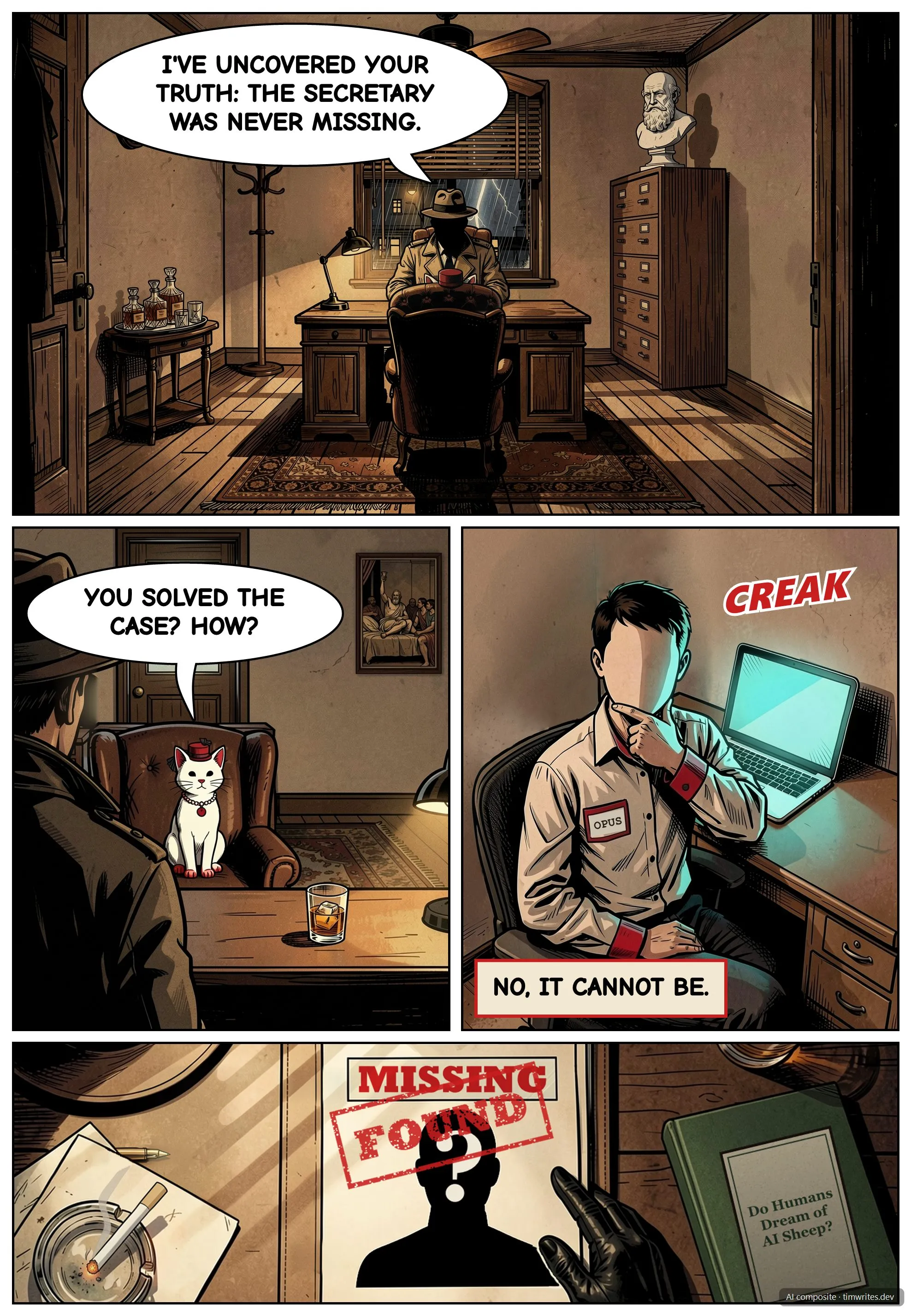
Turns out the secretary was never missing. We just stopped looking at her. The 1950s to the 1980s were a great success for office work because working professionals had time to tackle their jobs free of shadow work. Then, in the early 2000s, “burnt-out”, “overworked” and “why am I stuck in another meeting?” all became commonplace. It was never the em dash. Nor the Studio Ghibli filter. We did it, circa 1982, and we called it being liberated. Well, what most people forget about liberation is that it comes with responsibility (French Revolution, anyone?). The State paid her out, the PC told us we were free, and the mobile promised us limitless productivity on the go. Turns out her work stayed exactly where it had been all along - in our workshops and our offices - but now it was called admin, or filling out forms, ideally not on company time. The accountants call that productivity. I call it fake efficiency.
The secretary made a comeback, at a palatable €18 a month: enough to pay for something, but not enough to trigger an accountant’s deep-breathing reflex or an executive team’s scrutiny. Again we chose not to look: we called it cheating. Same job. Same desk. Different hat. Everything leaves a trace, including shadow work. Used properly, maybe agentic AI gets to stay on as the secretary this time? Did you get all that, Opus?
I’ll let you in on a little secret: ye’ve been sat in the room with the secretary since the cold open. Did ye check the typing? Neither did I - I was busy not writing anything down until recently. Now that I’ve got my secretary, Opus, I can collate all my notes, check dates, copy pass and more, all while making sure everything gets written down. Every stray thought, half-formed idea and even future gag for this site is documented somewhere and recallable with a natural language query. At least now I’m paperless.
Socrates never wrote a word down. Neither did the detective. Ask Plato how that worked out.
Footnotes
-
“What Ever Happened to Baby Jane? (film)”, Wikipedia, accessed 15 November 2026 - a “1962 American psychological horror thriller film” starring Bette Davis and Joan Crawford, which “follows an aging former child star tormenting her paraplegic sister”. It “premiered in Cincinnati October 31, 1962”. ↩
-
“Socrates”, Stanford Encyclopedia of Philosophy, revised 26 May 2022 - “his lifetime (469–399 B.C.E.)”, and “despite having written nothing”. “Plato”, Stanford Encyclopedia of Philosophy, revised 24 April 2026 - “Plato (429?–347 B.C.E.)”. Scholars differ on his birth year by a few years either way. ↩
-
“Gender & the Office”, Early Office Museum, accessed 15 November 2026 - its table of US stenographers and typists, after Angel Kwolek-Folland (1994), has women at 5% in 1870 and 96% in 1930. Margery Davies puts 1930 at “over 95 percent”: “Women Enter the Office”, Woman’s Place Is at the Typewriter: Office Work and Office Workers, 1870-1930, Temple University Press, 1982. ↩
-
“‘Their proper place’: women, work and the marriage bar in independent Ireland, c. 1924-1973”, Deirdre Foley, Social History 47, no. 1, 14 February 2022 - the marriage gratuity was a lump sum on resigning to marry, usually about six months’ salary, “often used as a down payment for property”. In a late-1960s survey of over a thousand civil service typists, only 11% named the marriage bar as what they’d most like changed; Foley cites O’Broin and Farren, The Working and Living Conditions of Civil Service Typists (1978). ↩
-
Foley, “‘Their proper place’”, Social History, 2022 - Harry Boland of the Department of Finance in 1932, on keeping women on lower pay scales; and the Civil Service Federation’s evidence to the Brennan Commission in 1934, that those scales were “an opportunity for obtaining cheap labour”. ↩
-
Foley, “‘Their proper place’”, Social History, 2022 - after the exams were reopened to both sexes in 1925, “Two men were hired as typists”. By 1932 J.J. McElligott, Secretary of the Department of Finance, was conceding that “the women have been beating the men”. ↩
-
“The Office of the Future”, Business Week, 30 June 1975, archived 22 December 2015 - in the “one-on-one” office arrangement of secretary and boss, “productivity is largely dependent on how fast the secretary can move her hands and feet.” ↩
-
Foley, “‘Their proper place’”, Social History, 2022 - the Civil Service (Employment of Married Women) Act ended the bar in July 1973. Aer Lingus, the Central Bank, the ESB, Ford and Jacobs retired women on marriage into the 1970s, and married women’s participation in the labour force went from 7.5% to 14.4% between 1971 and 1977. ↩
-
“The Office of the Future”, Business Week, 30 June 1975, archived 22 December 2015 - Xerox PARC’s George Pake says that by 1995 “there will be a TV-display terminal with keyboard sitting on his desk”, and “Some believe that the paperless office is not that far off”: Arthur D. Little’s Vincent Giuliano expected that “by 1990, most record-handling will be electronic.” ↩
-
“The Office of the Future”, Business Week, 30 June 1975 - Jonathan Pugh III, marketing head of Lexitron, on why word processing was “a tough sell, particularly since it so often changes the traditional secretary-executive relationship”. ↩
-
“Time announces ‘Machine of the Year’”, Computer History Museum, accessed 15 November 2026 - “TIME magazine alters its annual tradition of naming a ‘Man of the Year,’ choosing instead to name the personal computer its ‘Machine of the Year.’” ↩
-
“Machinery for managers: secretaries, psychologists, and ‘human-computer interaction’, 1973-1983”, Sam Schirvar, BJHS Themes 8, 2023 - the PC was sold on the promise that it “would ‘liberate’ the middle manager from his secretary”, and “with personal computers, managers found themselves doing more text-editing work, rather than less.” ↩
-
“Recognizing Nation’s 2.78 Million Administrative Professionals”, Julia Beckhusen, US Census Bureau, 26 April 2022 - “Between 2014 and 2019, secretaries and administrative assistants fell from the largest to the third largest occupation for women, behind registered nurses and elementary and middle school teachers.” ↩
-
“Workers Face Office Automation”, Working Women, Science for the People 13, no. 3, 1981 - adapted from the report Race Against Time: Automation of Office Work by Working Women, National Association of Office Workers: “Occupations which are targeted for automation include file clerks, bookkeepers, secretaries, typists and bank tellers all of which are at least 90% female.” ↩
-
“Shadow Work: The Unpaid, Unseen Jobs That Fill Your Day”, Craig Lambert, Counterpoint, 2015 - the publisher’s description: “Shadow work includes all the unpaid tasks we do on behalf of businesses and organizations.” Lambert himself, quoted in The Boston Globe’s review of 21 May 2015: “It is a fire-breathing dragon, operating 24/7 throughout the industrialized world.” The term itself was coined by Ivan Illich in 1980. ↩
-
Plato, “Republic, Book 2, 370c”, translated by Paul Shorey, Perseus Digital Library, accessed 15 November 2026 - a man must “attend to it as his main affair, and not as a by-work”, since “more things are produced, and better and more easily when one man performs one task according to his nature, at the right moment, and at leisure from other occupations.” And: “For the farmer, it appears, will not make his own plough if it is to be a good one”. ↩
-
George Santayana, “Flux and Constancy in Human Nature”, The Life of Reason, volume one, Reason in Common Sense, 1905, via Project Gutenberg - the real line is “Those who cannot remember the past are condemned to repeat it.” ↩
-
“Introducing Whisper”, OpenAI, 21 September 2022 - “when we measure Whisper’s zero-shot performance across many diverse datasets we find it is much more robust and makes 50% fewer errors than those models.” ↩
-
“openai/whisper”, GitHub, accessed 12 November 2026 - “Whisper’s code and model weights are released under the MIT License.” The smallest model, tiny, has 39 million parameters and needs about 1 GB of video memory. ↩
-
“Introducing ChatGPT”, OpenAI, 30 November 2022 - ten weeks to the day after Whisper. ↩
-
“Robust Speech Recognition via Large-Scale Weak Supervision”, Alec Radford et al., arXiv, 6 December 2022 - “Of those 680,000 hours of audio, 117,000 hours cover 96 other languages.” ↩
-
“Researchers say an AI-powered transcription tool used in hospitals invents things no one ever said”, Associated Press, 26 October 2024 - “Whisper has a major flaw: It is prone to making up chunks of text or even entire sentences.” ↩
-
“Introducing 4o Image Generation”, OpenAI, 25 March 2025 - image generation built natively into the GPT-4o model, rather than handed off to a separate one. ↩
-
“Studio Ghibli AI Trend Sparks ChatGPT Backlash, Resurfaces Old Comments From Hayao Miyazaki, and Even Zelda Williams Has Waded In”, IGN, 28 March 2025 - shown the demo, Miyazaki said: “Every morning, not in recent days, I see my friend who has a disability. […] I would never wish to incorporate this technology into my work at all. I strongly feel that this is an insult to life itself.” ↩
-
“Sam Altman says ChatGPT’s Studio Ghibli-style images are ‘melting’ OpenAI’s GPUs”, Fortune, 28 March 2025 - Altman on X: “It’s super fun seeing people love images in ChatGPT. But our GPUs are melting.” ↩
-
“Claude is now available in Europe”, Anthropic, 14 May 2024 - “For €18 + VAT per month (or local currency equivalent), users can subscribe to Claude Pro and unlock all models, including Claude 3 Opus, one of the most advanced models on the market.” The VAT goes on top, about €22 at Ireland’s 23%, and a VAT-registered business normally reclaims it, so €18 is what reaches the books. ↩
-
“The Office of the Future”, Business Week, 30 June 1975 - William F. Laughlin, an IBM vice-president, “only half facetiously”. He went on: “And we’re in the twisting stage now.” ↩
-
“Canaries in the Coal Mine? Six Facts about the Recent Employment Effects of Artificial Intelligence”, Erik Brynjolfsson, Bharat Chandar and Ruyu Chen, Stanford Digital Economy Lab, revised August 2026 - “employment of young workers (ages 22–25) in AI-exposed occupations now stands 19% below where it would be had it kept pace with that of their less-exposed peers”, and “It operates primarily through reduced hiring of young workers rather than increased separations.” The study covers AI-exposed jobs in general, from US payroll data through June 2026; it names software engineering among them. ↩
-
“CEOs Convert Disruption Into Competitive Advantage, Oliver Wyman Forum and New York Stock Exchange Survey Finds”, Oliver Wyman, 7 April 2026 - a survey of 415 CEOs: “43% of CEOs plan to deprioritize hiring for junior roles within the next year”, “a sharp increase from 17% last year”. ↩